Showing posts with label controversy. Show all posts

Thursday, April 20, 2006

Thursday, April 20, 2006

(Photo: Bragg's Liquid Aminos seasoning)

Today I ate pretty much the same small meal repeatedly- salad in various forms. I also had a fruit smoothie into which I added about 3 oz. of lettuce (rather than having a green smoothie into which I add some fruit).

The photo above is the Bragg Liquid Aminos. It appears in so many raw recipes that we bought some a couple of weeks ago. It's very salty and reminds me of strong soy sauce. Felicia used it in the nut burgers she made last week. To be honest, I can't say I like it- it's way too strong and salty for me.

I have no idea why so many recipes call for this seasoning- can it really be totally because of the taste? I did a little reading on it and I guess people consider it to be a raw product that provides the protein raw food eaters want in their diet. However, there apparently is some controversy over the "raw" claim and the safety of the product. I know there are people who swear by this stuff (like Juliano, apparently, since so many of his recipes call for it).

I found a post on We Like It Raw where people talk about some negative aspects of the product. To be fair, here's a link to Bragg's site so you can read what they say about their product. As usual, we need to do our homework. Caveat emptor.

Tuesday, February 21, 2006

Raw Foodists and Protein Revisited

According to NutritionData.com, here are the essential amino acids the human body needs from foods to create a complete protein.


Essential Amino Acid
mg/g of Protein
Tryptophan 7
Threonine 27
Isoleucine 55
Leucine 25
Lysine 51
Methionine+Cystine 25
Phenylalanine+Tyrosine 47
Valine 32
Histidine 18

NutritionData has this cool feature where you can look at the amino acid content of individual foods, so I thought I would revisit the protein controversy. The website acknowledges that their assessment of protein quality is affected by the body's ability to digest it and how the food is prepared (quote: "protein digestibility depends on the type of protein (animal proteins are more digestible than plant proteins), as well as the method in which the food was prepared")*

What I like about the analysis page is that regardless of whether the protein is actually digestible, I can see what amino acids exist in the food in the first place. If someone says I can get all the protein I need from raw vegetables but I don't see that all the amino acids even exist in the vegetable in the first place, I can't help but be a little doubtful about that, you know?

NutritionData takes the lowest amino acid in any food you look up and lists complementary foods that are higher in that amino acid (to make up for what you are missing) and/or lower in the amino acids that are sufficient. I looked up mushrooms and found that the ones I chose were low in methionine+cystine. A link led me to a list of 999 foods that they say complement the mushrooms by providing methionine+cystine. Luckily, the list is broken down into food groups, such as "nuts and seeds" and "vegetables & vegetable products", etc. It was way too long a list for me to wade through, but I did see that Brazil nuts have the amino acids missing from the mushrooms.

To read what NutritionData has to say about proteins, click the link below.

* http://www.nutritiondata.com/images/protein-quality.jpg

Sunday, January 29, 2006

Are You Raw Foodists Getting Your Complete Proteins? (update)

One of the most common questions asked of a raw foodist is "where do you get your protein?" Although the only person who's ever asked me that is my mother, I figured I'd post some protein information for other newbies to the raw food lifestyle so you can tell your own mothers (and other relatives, friends and acquaintances) that yes, you can get complete proteins without eating meats or dairy. I got this from a nutrition guide at the university bookstore. This is one of those guides they provide to people majoring in nutrition or food science. I would encourage people to pick up this kind of information as well, just as a reference guide.

Complete proteins are considered high quality for humans because they contain all of the essential amino acids. They are easily digestible. Foods in this list include

  • Eggs

  • Milk

  • Cheese

  • Poultry

  • Fish


  • Now, for those of us who eschew meat and dairy, where should we look? Plant proteins are considered complementary proteins because not only can we not get all of our essential amino acids from one plant, we'd have to eat a lot more plants per serving than meat or dairy to get the same amount of protein. However, by combining complementary proteins, you can create a meal containing all of the essential amino acids- a complete protein meal.

    Here are foods belonging to the complementary protein category:

  • Grains

  • Legumes

  • Nuts

  • Seeds

  • Vegetables


  • You basically combine foods from this list that "compliment" one another to form complete proteins. You therefore don't have to have a complementary protein along with meat or dairy. My nutrition guide says you can combine:

  • Vegetables with legumes, plus either nuts or seeds

  • Vegetables, grains and legumes

  • Grains and legumes

  • Nuts, seeds and legumes

  • Grains and legumes


  • The guide says that the protein requirements (Recommended Daily Allowance) in grams is only .8 g of protein per kg body weight per day for people aged 19 and up. (I hate it when measurements are done using the metric system!) I invite someone to do the math if you are willing. There are also charts on the internet that you can use to calculate daily grams of protein per day.

    I never really thought about how I can combine plant proteins. All I remembered was that old adage about beans and rice making a complete protein. I never would have considered vegetables plus nuts, for example, as fulfilling a complete protein requirement. I'll be sending this post to my mother posthaste!

    I hope this information was helpful to others.

    -Allison

    UPDATE, Jan. 29, 2006
    I received an excellent comment from someone who states that the above information is outdated and inaccurate because 1) it's been discovered that plants have all of the essential amino acids humans need and require no combining and 2) raw plant protein is better utilized by the body and therefore less protein is needed than is traditionally recommended. (If you click on the "comments" link below this post you can read the entire entry).

    Unfortunately, protein is one of the controversies faced by the raw food/vegan/vegetarian community. What I printed above is certainly not considered outdated by all people -indeed, this information can be found on recent entries at medical sites like WebMD, and is still widely published and taught. So here is another area where raw foodists just have to decide for themselves what they want to do: go with traditional advice or believe that this advice has been proven false. You'll find ardent supporters on both sides of the table. Personally, I'll be doing a lot more reading and investigating before I consider the old information outdated, but I am always open to learning.

    Thanks again for the input.

    Monday, January 23, 2006

    Jan. 23, Day 23 - Today I Tried 3 Kinds of Raw Nuts


    Well, my meager funds have finally arrived! I didn't really have time to shop so I just bought some nuts today at Wild Oats. Their selection of raw nuts is much wider than Whole Foods (but they didn't carry the nama shoyu I was hoping to find). I bought raw walnuts, raw almonds and raw cashews. I know the controversy over whether these nuts are truly raw and frankly, all the contradictions and differing definitions among raw foodists are becoming very annoying to me. I'm really happy that it's not necessary to me to be 100% raw! That way if I discover later that something I'm liking isn't raw I won't have a hissy fit over it. It's not like something has no nutrients at all just because it isn't raw.

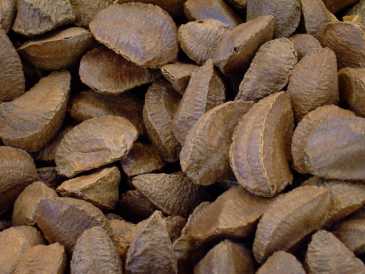
    The raw almonds were a bit softer than I thought they'd be, but they were fine (I'm not a big almond fan). The walnuts tasted and looked the same as all walnuts I've seen. The raw cashews were very pale and naked-looking. I was afraid I'd be disappointed by their taste but they were nice- a tad sweet and buttery. They'll make a good pate when I get that blender this week! By the way, if anyone knows what kind of nuts those are in the photograph above, would you tell me? I would have bought a few but I figured I'd better find out what they are first. In fact, there are a couple of other nut photos in this blog. If anyone can identify those, too, I'd be grateful! I take these photos when I'm at the store, but the bins aren't always labeled.

    Today was my first day of classes where I was satisfied with what I took with me. I took a hummus sandwich, a banana and a 1.5 oz. box of raisins, plus 16 oz. of water. The raisins were the only things I didn't eat. The meal/snack sustained me quite well. I wasn't starving when I ate it and I wasn't starving for hours afterwards. I ate in an open location so the garlic and banana aromas didn't annoy anyone! Now that I have nuts I will made a nuts/raisins/goji berries mix. (Note to Ren: should I try cacao nibs in the mix??)

    For dinner I made sushi and tried soaked quinoa rather than soaked bulgar. BIG MISTAKE. It even SMELLED bad to me! Quinoa is very high in calories, I learned (after the fact, of course). I was shocked! It appears to be a good source of protein, too. I've listed the calories below in the dinner category. Maybe if I find a recipe for quinoa I'll buy more. For now, it's goes with the jicama, cacao nibs and cauliflower as Foods I Don't Like.

    Oh- speaking of cacao nibs, my girlfriend ground up a few and mixed them in with her coffee grounds. That was my idea, I'll have you know. She said she got a nice hint of chocolate, but that she'd have to add a lot more to make it truly influential. Unfortunately, she doesn't think it's worth 9.99 to add mocha flavor to her coffee. Oh, well, I'm getting the blender and will see what I can do with the nibs. (That sounds funny- "the nibs").

    Before I sign off- thanks to those who have been replying with cacao ideas and uncookbook info at either blog site. Now that I have money I'm really ready to buy a book!


    BREAKFAST
    Ezekiel 4:9 Sprouted Grain Bread, 2
    Hummus, 0.25 cup
    Romaine Lettuce (salad), 1 leaf
    Avocados, California (Haas), 56 grams
    Taboule Salad, 4 tbsp
    Centrum with Lycopene, 1
    Nature Made Calcium Citrate, 1

    LUNCH (I took this sandwich to school and ate it during a break)
    Taboule Salad, 3 tbsp
    Ezekiel 4:9 Sprouted Grain Bread, 2
    Hummus, 0.25 cup
    Romaine Lettuce (salad), 1 leaf

    DINNER (SUSHI)
    Sushi Nori, Raw Untoasted, 1 sheet, 4
    Avocados, California (Haas), 0.7 fruit
    Cucumber (peeled), 3 stick (4" long)
    Baby Carrots, raw, 1 medium
    Quinoa, 0.2 cup ------> This had 127 calories for less than 1/4 cup!!
    Soy Sauce, 0.33 tbsp
    Spinach, fresh, 15 leaf

    SNACKS
    Walnuts, 0.5 oz
    Cashew Nuts .5 oz
    Almonds, 3
    Mango
    Banana, fresh, 1 large I ate this at school during a break
    CALORIES 1,589 CARBS 213 FAT 66 PROTEIN 54

    Thursday, January 19, 2006

    Raw Cacao, Anyone?


    I've been reading about the amazing, beneficial properties of raw cacao, so I decided to check out this "superfood" myself. According to people who eat raw cacao, they feel more alert, have more energy, and in general feel happy. Promoters of raw cacao (such as David Wolfe, a nutritionist well known and respected by raw foodists, and Nature's First Law, which sells raw foods) claim that raw cacao is amazingly healthy because it is high in magnesium, has chemicals which promote a feeling of happiness, and reduces appetite. It is the "raw" aspect that really draws raw foodists and which attracted my attention. I wondered what this stuff tasted like, so I went out the Whole Foods Market and bought an 8 oz. bag of Nature's First Law "Certified Organic Raw Chocolate (Raw Cacao Nibs)" for the extreme price of $9.99 (the same price it is sold for online at Nature's First Law). This was the only raw cacao I could find in the store.

    TASTE TEST
    Upon opening the bag, a strong, not unpleasant chocolately aroma wafts out. My girlfriend and I both think it smells like a mocha-flavored coffee as it's roasting at Starbucks or someplace. I looked at the nutritional information and was quite surprised to see no mention of the huge amounts of magnesium that is supposed to be present in raw cacao. I did notice that there are 11 grams of fat in one ounce (4 of them saturated). The other listed nutrients are: 30 mg of sodium, a total of 14 grams of carbs, 9 grams of fiber, 3 grams of sugar, 1 gram of protein, and 42 mg of Vitamin C.

    I placed one tablespoon of the nibs in a little bowl and tasted some. First impression? YUUUUUUCKKK!!!!! Oh. My. Gawd. This stuff is bitter and...and... I just didn't like it at all. My friend tasted it next and made some gruesome faces (which she refused to let me photograph for the blog). We tried to like it- after all, it's supposed to be good for you. But the truth is, our first impression is that we cannot stand this stuff.

    CONTROVERSY
    I decided to do some investigation about this product. Unsurprisingly, it turns out to be the center of yet more controversy amongst raw foodists. Nature's First Law describes the cacao bean as the seed of a fruit, and describes its beneficial influence on mood and appetite. It downplays its stimulant properties in a section called "Stimulant or Superfood?" which led me to believe that there must be concerns about cacao's stimulating effects. Nature's First Law says that it is cooked cacao that has the stimulating effects that concern nutritionists, not cacao in its raw form.

    So what does the other side say? I found several articles that are vehemently anti-raw cacao- or, more accurately, against the marketers of the product. Their most common concern is the claim by raw cacao promoters that raw cacao is truly raw. They claim that the fact that Nature's First Law's raw cacao nibs are peeled is proof that the beans/nuts have been roasted (cooked) and therefore have none of the enzymes that raw foodists are after in a raw diet. Another site shows that raw cacao is naturally white; its brown color comes from fermentation- another process whose effects on foods raw foodists disagree about. One website goes so far as to accuse a particular promoter of raw cacao of scamming the public.

    MY TAKE
    For me, the only true raw foods are the unprocessed raw fruits and vegetables I see in the produce section! As consumers we certainly can't trust the labels on processed foods; for example, cashews labeled "raw" are actually, according to some raw foodists, heated to temperatures that kill their enzymes. And the whole enzyme theory that is the basis of raw foodism itself is a point of controversy! There are nutritionists and scientists who say that enzymes from raw foods are not utilized by the body in the way raw food promoters claim they are, and that raw food diets are no more healthful than cooked food diets.

    WHAT'S A RAW FOODIST TO DO?
    I have come to realize that I am not into the whole enzyme theory. This disqualifies me as a classic raw foodist, I suppose, but I'm not trying to fit into any community. I'm just an average citizen trying to get healthy. If raw foods have a miraculously beneficial effect on me, I'll accept that these benefits have occured. But I'm not going to attribute them to enzymes, since that theory has not been proven. If others want to attribute such benefits to enzymes, that is fine for them- maybe the theory will be proven once and for all one day. I have nothing against the theory; I just don't see it as anything more than that- a theory. And whether or not the theory is fact doesn't change my experiences: I've had a tremendously easy weight loss so far, and the raw foods I've eaten (with the exception of raw cheese) have not produced any of the cravings or desires to binge that I'd always experienced before. I therefore have no plans to stop eating raw! And although the many controversies within the raw food community are a concern to me, I will still try new products and see if they work in my new raw lifestyle.

    But I won't be eating raw cacao any time soon!


    Here are sites I read while looking for information on this topic. I urge you to read them, and other resources, yourself so you can come to your own conclusions.

    Jan. 22 UPDATE: I have added a publication by Nature's First Law because in it, they claim to not roast their cacao. The publication is listed in the Pro-Raw Cacao list below.

    Pro-Raw cacao
    David Wolfe's website
    Rawfood.com
    Nature's First Law, the marketers of the raw cacao nibs.

    "Anti"- Raw Cacao
    Rawbakery.com
    fredericpatenaude.com

    General Raw Cacao Information
    Essentiallivingfoods.com

    Cooked vs. raw:
    Beyondveg.com

    FIVE MOST RECENT COMMENTS

    Tags

    FeedBurner FeedCount